Why Singapore's Dentists Lose Their Neck Curve, From the Structural Correction Specialist Their Own Association Invited to Teach Them
In 2009 the Singapore Dental Association invited a Swedish-trained chiropractor to explain the musculoskeletal price of the job. He is not the crack-and-adjust kind. He measures the neck's structure in degrees and rebuilds it, and this is what he shows the surgeons and dentists who now come to him as patients.
You already know the posture. Bent forward, rotated to one side, holding a fixed position with a level of stillness most people never demand of their body. For minutes at a time. For hours a day. For years.
Every course in dental school was about their bite. Not one hour was about your neck, and how to protect your health.
So it creeps in. The stiffness by the end of the list. The ache that starts in the neck and reaches into the shoulder. The morning you notice your head sits a little further forward than it used to in the mirror. You stretch between patients. You book the occasional massage. It buys you a few days, and then you are back in the chair and it is back in your neck.
This is not wear and tear. It is a specific, measurable problem
Here is what a structural correction specialist who has spent 21 years working in structural correction and at least 10 years exclusively on necks will tell you: for professionals who hold precise, static, rotated postures, the issue is rarely just tight muscles. It is structural.
A healthy neck holds a gentle forward curve. Years in a fixed, head-forward working position can flatten or even reverse that curve. Once the structure drifts, the muscles have to work overtime just to hold your head up. That is the tightness. That is the fatigue. That is why the massage never holds: it releases the muscle, but the structure pulls it right back.
"Dentists and surgeons are almost a textbook case. The very thing that makes them good at their job, that steady, precise, held posture, is what loads the neck. And most of them do not even know it can be measured, let alone corrected. So they treat it as part of the job and let it quietly deteriorate."
The part that matters to you: your hands and your years
For most people, neck pain is a comfort problem. For you, it is a career problem.
The pain does not stay in the neck. Left to progress, a collapsed cervical curve can irritate the nerves that run into the shoulder, the arm, the hand. The hand your entire profession depends on. Most dentists and surgeons are not afraid of discomfort. They are afraid of the version of this that reaches their grip, their precision, their focus, and quietly shortens the number of good years they have left at the chair or the table.
You have probably watched it happen to someone senior to you. The colleague who slowed down. Cut their list. Retired earlier than they wanted to, and did not quite say why.
Why nobody flagged it for you
You know anatomy better than most patients who walk through his door, so this next part tends to land fast.
When a doctor reads your neck X-ray, they are scanning for damage: fracture, tumor, severe degeneration. If none of that shows, the report says "normal," and you are sent off with painkillers or a physio referral. Measuring the curve in degrees, and correcting it, is simply not what that scan is for.
And a typical chiropractic clinic sits on the other side of the gap: a quick adjustment, a satisfying crack, relief for a few days, and a standing weekly appointment forever. The structure is never measured, so it never changes.
This is worth saying plainly, because it is the whole point: Dr Kalla's practice is not a typical chiropractic clinic. It is a structural correction clinic. Every case begins and ends with a measured X-ray. The goal is to rebuild the curve itself, tracked in degrees, and then to end, not to keep you coming back.
The credential that fits your world
Dr Will Kalla trained at the Scandinavian Chiropractic College in Stockholm and has 29 years of international clinical experience, 21 of them focused specifically on structural correction. In 2009 the Singapore Dental Association invited him to deliver a session titled "The Common Musculoskeletal Disorders Associated with the Dental Profession," because this problem is that common, and that specific, in your field.
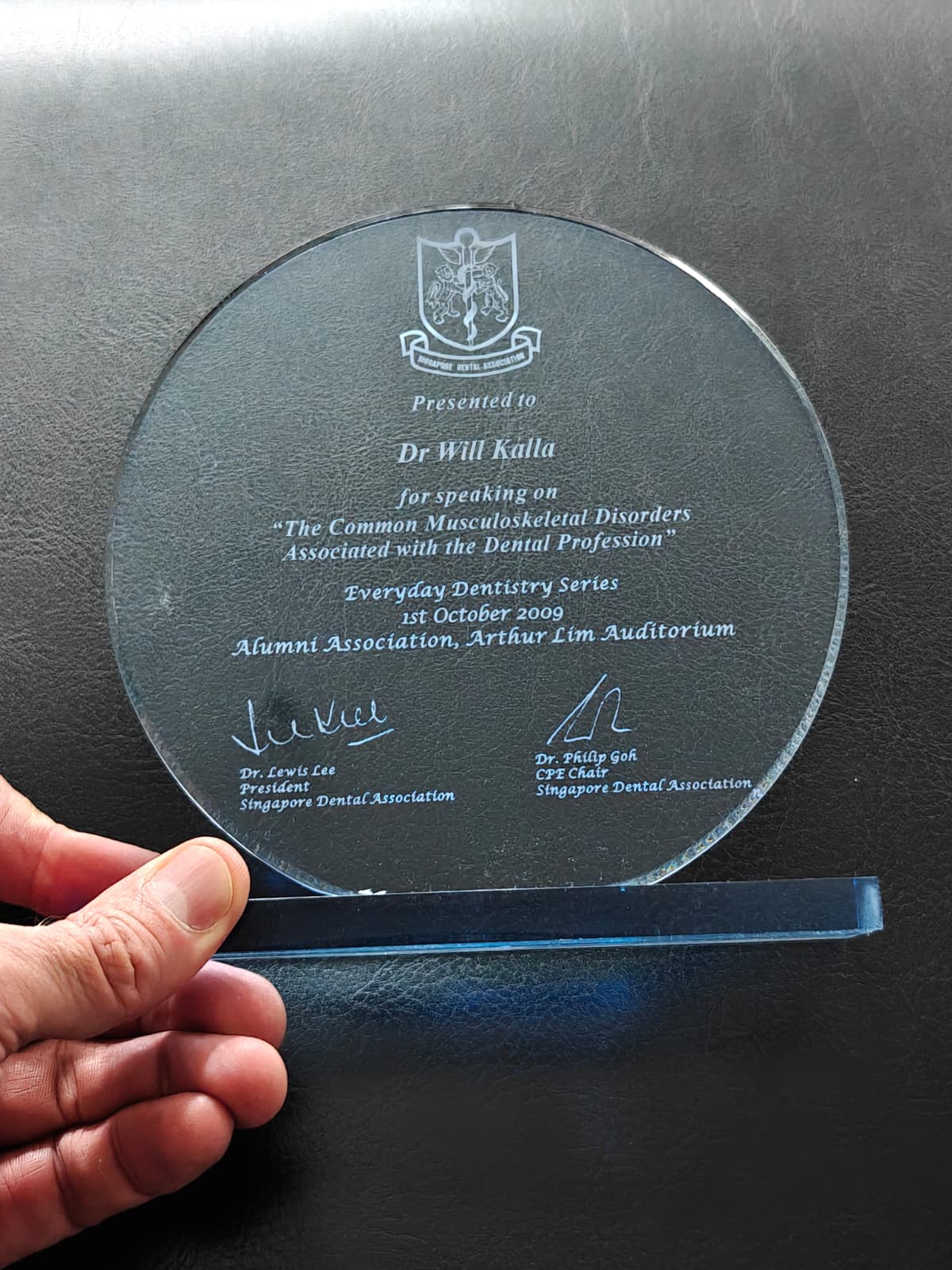
He has been featured on Channel News Asia and in The Straits Times, and he personally conducts every initial assessment.
Want to know what your own cervical curve measures, before you commit to anything?
No obligation. If it is not a fit, he will tell you straight.
The evidence, including the honest parts
The structural approach is measured, so the proof is measured too.
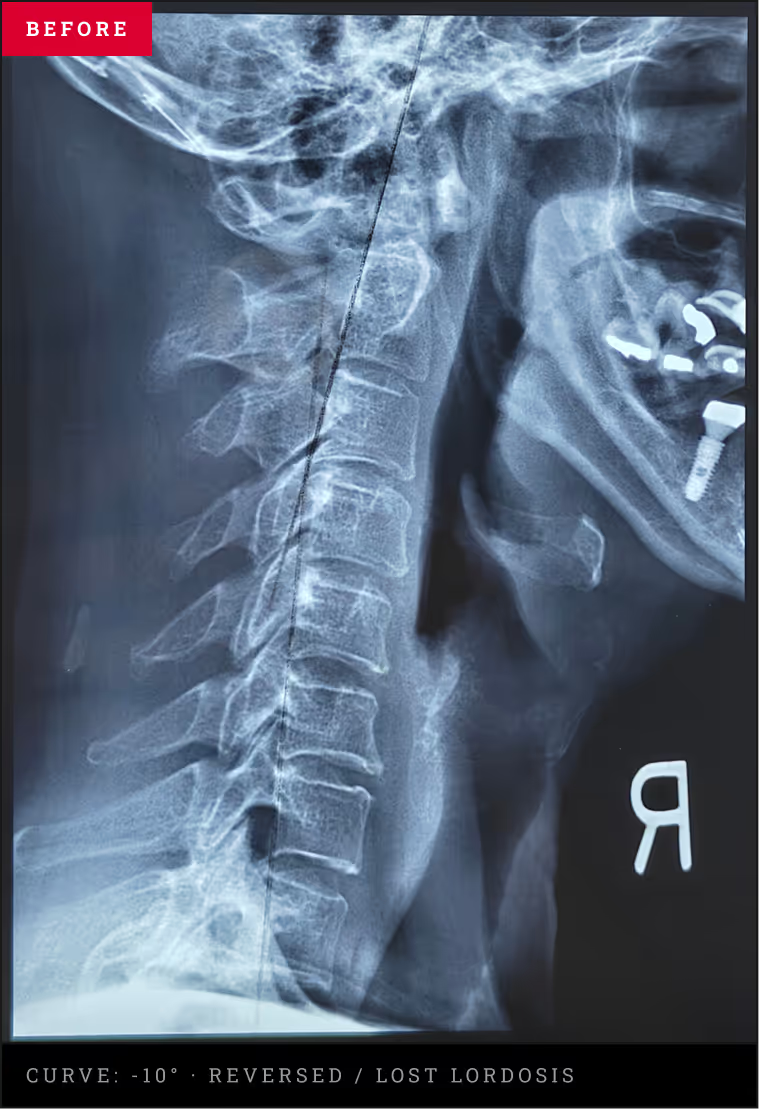 Before
Before · Curve: -10° · Reversed / Lost Lordosis
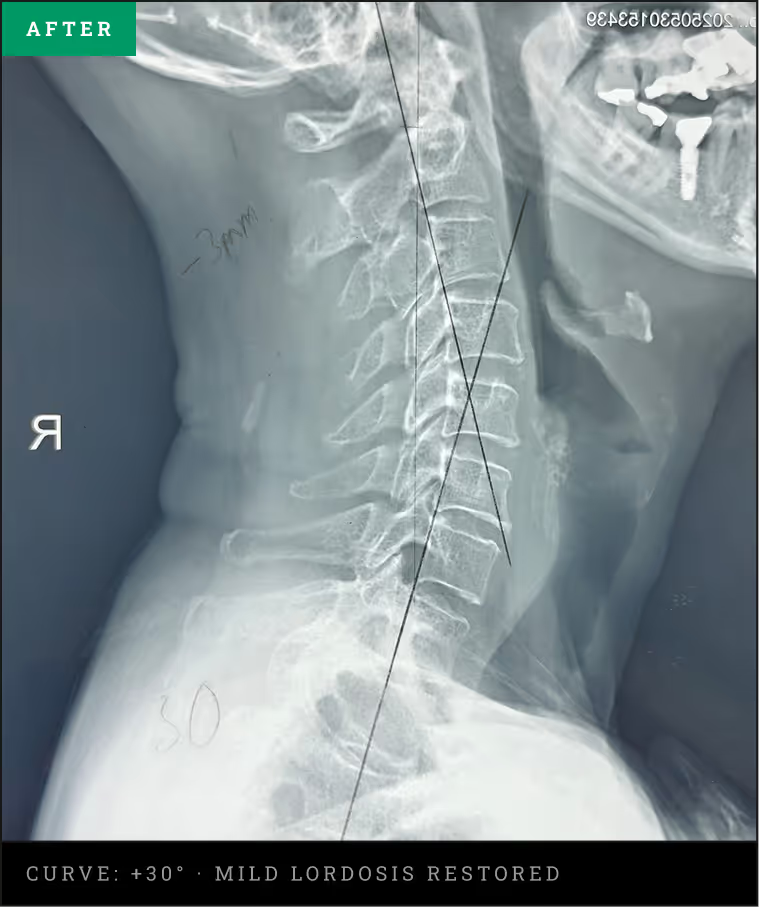 After
AfterAfter · Curve: +30° · Mild Lordosis Restored
Take one case the clinic documents publicly. A patient came in with his cervical curve reversed to negative 10 degrees, the healthy forward curve gone entirely, and numbness running down his right arm severe enough that gripping had become difficult. Sports massage and conventional adjustments had given him nothing. Over a measured course of structural correction, his curve was rebuilt from negative 10 to positive 24 degrees by session 12, and to a normal, healthy positive 30 by session 24. The arm numbness resolved within a month.
The profession differs. The structure does not. That numbness down the arm is the same nerve pathway that, for a dentist or surgeon, eventually reaches the hand your work depends on.
The occupational pattern is real and well documented outside the clinic too. As one dental hygienist put it after 23 years in the profession: "I am suffering from my forward head posture while working. Trying to fix 23 years of damage." She is describing exactly the mechanism above.
And to be straight with a skeptical, evidence-minded reader: not every case reaches 100 percent. One patient rated his years-old neck tightness a 4 out of 10, and after treatment rated it a 2. Better, not perfect. The clinic publishes cases like that one on purpose. Structural correction is not magic. It is measurable, and some necks correct further than others, especially older or more degenerated ones.
How the correction works
Three phases, the same sequence for every case, adjusted to the individual and re-measured on X-ray along the way.
- 1RELEASE
Loosen the deep tissue restrictions and prepare the neck for realignment.
- 2RESET
Reset joint mobility and structural alignment at the neurological level.
- 3RECALIBRATE
Retrain the posture map so the corrected position starts to hold on its own.
You see the degree change on film, not just how you feel that week.
"I know my posture is bad. I stretch. I've heard the chiropractor warnings."
You've probably heard that warning before. Dr Kalla gives it too, more bluntly than most: fast, forceful cracking on an unmeasured, degenerated neck is reckless.
But an X-ray isn't what makes this different. Plenty of chiropractors take films. What's different is what happens after the film: a system, R3NEW X™, that Dr Kalla spent 12 years developing, running on equipment he designed himself specifically to move a curve, not just photograph one.
Reading your films first is the floor, not the differentiator. Nobody else runs what happens next.
As for stretching between patients: it is not nothing, but it works on the muscle, not the structure. If the curve has drifted, stretching manages the symptom while the underlying loading continues.
And on time, the objection every busy practitioner reaches for: the clinic is a five-minute walk from Bugis and City Hall MRT, sessions are scheduled around a working day, and many corporate and professional insurance plans in Singapore cover chiropractic care.
The decision
You can keep stretching between patients and booking the occasional massage, and let the structure keep drifting on schedule. Many do, for years, until it reaches the hand.
Or you can find out what your own cervical curve actually measures, in degrees, and whether it can be restored before it costs you time at the chair.
Dr Kalla offers a free phone assessment. It costs nothing, there is no obligation, and if your case is not a fit, he will tell you straight. If it is, the next step is a full structural X-ray evaluation, so you can read your own films the way you read your patients'.